Showing posts with label Written Tasks. Show all posts

Saturday, 5 February 2011

Reflective Statement- for Blog

Stage 1 Reflection


Rough Guide


I really enjoyed getting to know my assigned area. It was a great way to introduce ourselves to our classmates and to get settled within a small part of London. I re-visited the area a few times to make sure I had ticked off every suggested stopping point and recorded this with photographs and factual information about the retailers. If I was to do the overview again I would make more time for absorbing the culture for example soho is famous for afterhour entertainment that would have been interesting to document.

Winding and Wrapping work

I think this workshop was really benificial. I continued developing some samples after the day to help develop my weave and on occation knit work and example is shown below:


I maybe should have spent more time on my sketchbooks rarther then my wrappings.

Postcard Project

A creative piece of administration, not very benifical, but an enjoyable reminder that I have enrolled into an art collage not just a boring university. Could have been more information on freshers week.

Inductions

The libary and computer inductions were benificial in order to set up accounts and systems within the network, however if they had been on the same day it would have saved traveling exspenses and time.

Blogging

Overall I have enjoyed Blogging on blogspot and think I have come to terms with the blogging processes; it is a very user friendly tool to present design ideas and work for assessment. I think positively that I have presented my work clearly enough to be assessed with ease. The negatives of my blog is that visually and even mentally is is not attractive for any irrelevant onlookers, on my next blog I hope that I can develop the graphics to a higher standard and enter more of my own self induced posts.

200 word Object Analysis


The Object is a piece of sculptural art created by Louise Weaver. The sculpture uses a Victorian taxidermy model of a peacock. The artist has crafted the bird famous for its extravagant feather display, a stripy decorative skin using techniques of crochet, applique and weaving. The artist describes her work a a development in her interest in distinction between artificial and natural. There are many discussions of debate for the secondary meaning of Weaver’s sculpture. The bird is a common example used by biologists of a model of Darwin’s theory of natural selection as the potent force in evolution. Survival of the fittest allows the best combinations of natural heritable characteristics to develop; in the case of the peacock the males develop a beautiful bouquet of feathers to attract the opposite sex during courtship; its feathers demand attention. Weavers coat emphasises the birds physique and links her sculpture to our human psychology and own courtship rituals. I recently visited the Royal academy hosting the exhibition: Awear: Art, Fashion, Idenity. The work in the exhibition is described: “clothing as a mechanism to communicate and reveal elements of our identity.” The Peacocks coat symbolises fashion. Fashion changes in its own evolutionary cycle but how has it developed to stimulate our biological rhythms. Many theorists such as Gabriel and lang write about fashion as as extention of our idenity, as time contnues are our fashion idenities getting more extravagant?

Thursday, 6 January 2011

Orientalism in Design - Chinoiserie

The interest in the East was stimulated during the late 18th and early 19th century by objects imported from Asia and by newly-published books on India and China. The scenes illustrated in these volumes provided British designers and manufacturers with fresh sources of inspiration
The fashion for Chinese themes in decoration in Western Europe grew and as a term was called Chinoiserie. Western designers attempted to imitate the technical sophistication of Chinese designs with only partial success.

Artists took influences not only from the sophisticated Chinese designs but also from India and later Japan (Japonism or japonesque art movement) In many designs the interpretations crossed over to form juxtaposed finishes. These were seen in many forms amongst the fashionable British society including: fashion, ceramics, product design and even architecture. Below are examples or the good and bad imitations:


Most popular chinoiserie, refers to the imitation of ceramics especially Ming decorations from the early 17th century. The Chinese blue and white ceramics were incredibly popular and British potters were producing large quantities of inexpensive transfer-printed earthenware to satisfy the growing market. The Chinease design technique above actually shows a detailed scene of India a good example of the juxtaposed British designs.


To British designers the dragon was the ultimate symbol of China. The mythical beast occurs in various designs of the early 19th century, and continues to crop up as a symbol. As the Orientalism grew in fashion, British designs continued to use sterotypical scenes as a clever marking tool. Others included the willow pattern famous within British ceramic designs, as an invented scene or love story.


The Pagoda, Kew Gardens
Sir William Chambers

There was a fashion for Chinoiserie in English garden design in the mid 18th century. Sir William Chambers was a keen advocate. The Pagoda was completed in 1762 it was the tallest reconstruction of a Chinese building in Europe. The ten-storey octagonal structure is 163 ft (nearly 50 m) high. The original building was very colourful; the roofs being covered with varnished iron plates, with a dragon on each corner. There were 80 dragons in all, each carved from wood and gilded with real gold.

Purists, however, argue that pagodas should always have an odd number of floors. Kew's Pagoda tapers, with each successive floor from the first to the topmost being 1 ft (30 cm) less in diameter and height than the preceding one.

Orientalism in Design - “the far East”

Orientalism in Design
“the far East”

In the 1830s the development of steamboat and rail travel, and the accession of Queen Victoria, meant the eastern Mediterranean world could be accessed relatively easily. This included: Egypt, Palestine and Turkey. Theses predominantly Muslim areas then became known as the Orient or "the far East". British artists then soon travelled, spreading across the world in search of new and exotic subjects and developed imagery which captured what they believed to be characteristic of the people, cities and landscapes of the region. Those who went to the Middle East became known as Orientalists. In many of these works, they portrayed the Orient as exotic, colorful and sensual.

Fashion

Before 1830s private travel to the Middle East was rare; but travel for warfare, diplomacy, trade and religion had been going on for centuries. Those who travelled adopted a 'Oriental costume' fashion style. It made them feel safer, incognito, or even committed solidarity when researching. When they returned to the mainland they brought back these adoptions and the purchases they had made, the style was different, exciting, exotic and fashionable. The fashion spread and cropped up amongst juxtaposed western designs.


David Wilkie
Mrs Elizabeth Young in Eastern Costume, 1841


Art and Politics

In the nineteenth century, when more artists traveled to the Middle East, they began representing more numerous scenes of Oriental culture. British artists came from a culture steeped in technical and compositional traditions. Despite the apparent difference of the people and places they encountered, they found the Orient inspiring and challenging and began to try to unravel the new culture.

In 1978, Edward Said, Palestinian-American scholar, published his dissertation on Orientalism. His publications had sparked global debates over western representations of the Middle East. He described the current work interpreting the East, by Western academics and artists, as prejudice and shaped by the attitudes of European imperialism.

For many, Said’s overview is agreed with and the representations in artworks are now classed as fiction and the artists works were created to serve the western desire for control over the East. An argument supported by the next steps in history which saw, by the 1920s, Britain in direct control of much of the newly-abolished Ottoman Empire, including Egypt, Palestine and Iraq.

Below are a few examples of painting produced during the 18th and 19th century that are considered examples of Orientalism. Work that cannot be viewed in isolation from their wider political and cultural context.


William Holman Hunt
The Lantern Maker's Courtship (1854-57)

In the painting, a lantern maker feels a woman's face through her veil, without removing it.

I feel in this picture the Latern maker is portraying the feelings of the young British painters desire to touch rather then an observed scene from the Far East. It shows European colonialism’s desire to unveil the Muslim woman from their strict Hijab dress code. The traditional Muslim dress covered most of the skin, however desire developed because underneath the one layer that the women wore, they were less bound then the constricting western style of dress which included corsets.

Eugène Delacroix
The Women of Algiers

The picture is of inside The Harem; a room in a household which was forbidden to men. In reality to women would be rushing around within the area getting ready etc. However the Western depiction of the scene was often sexual. Above the woman are lounging around in an attractive relaxed tone waiting to be called upon by the men.

In Said's Orientalism, he brings forth the issues relating to the sexual and sensual nature of many Oriental artists. With the "European invention" Middle Eastern women are often depicted as sensual creatures whose only use was to be sexual slaves to men. The painting above is more respectable then some example where women at Turkish baths are having sexual orgies or preparing themselves in sexual positions. This is a degrading portral of the East.


Jean Auguste Dominique Ingres
La Grande Odalisque

In the painting lays a lounging odalisque, a woman slave, stressed both lassitude and as a visual spectacle. From a political concept the paintings could be seen as deeming as the exotic woman of the Orient had given herself up for the white man as he did his study.

Tuesday, 4 January 2011

Exhibition - V&A - Diaghilev

Diaghilev exhibition at the V&A
notes and reflections ...
Serge DiaghilevAbout 1924

The Ballets Russes, Diaghilev finest creation, toured the world between 1909 and 1929. It continued through the hardships of the First World War and the Russian Revolutions. Cut off from their routes and where they had preformed before 1914, it was an amazing achievement that the productions continued. This achievement was because of Diaghilev.

Serge Pavlovich Diaghilev was born in 1872. He was known to have a unique character and driven ambition. He was an elusive man who seemed unaffected by the war or his countries political hardships; a patron to modernism, yet a deeply conservative person who lived mostly out of hotel rooms, and with only the companionships of his company who he treated as extended family. When he died in 1929 he left few possessions including a large collection of literature and a top hat.

Diaghilev had combined dance, music and art in bold ways to create "total theatre". He transformed even revolutionized the world of dance and theatre from the stuffy white tutu and embraced the modern and exploited the avant-garde to create exotic performances. His work is still inspiring and influencing the culture of today, an astonishing legacy of music dance and art.
Below are notes information taken from the V&A website discussing The Ballet Russes:

Ballets Russes dancers in an on-stage dance class1928

The First Seasons, 1909-14
On 19 May 1909, after weeks of publicity, Diaghilev launched his first season of Russian ballet in Paris. Audiences were dazzled by the dancing and striking designs. Over the next few seasons a self-consciously Russian element dominated the productions. Innovative music magnified their impact, in particular that of Igor Stravinsky. The company's principal choreographer was the Russian dancer Mikhail Fokine.

Visually, the first Ballets Russes seasons were marked by the exotic designs of the Russian-born artist Léon Bakst. His bejewelled colours, swirling Art Nouveau elements and sense of the erotic re-envisioned dance productions as total works of art.

Following his critical triumph in 1909, and despite a financial loss of 76,000 francs (over £350,000 today), Diaghilev was in demand across Europe. So in 1911 he established the Ballets Russes as a year-round touring operation rather than a seasonal enterprise.
Signed photograph of Vaslav Nijinsky in Le Spectre de la rosePhotograph by Bert1912
Nijinsky: A Force of Nature

The virtuosity and charisma of Vaslav Nijinsky (1889-1950) were such that no one who saw him perform, it was claimed, ever forgot him.
He transformed himself for each role he danced. Trained in the Russian Imperial Ballet, he was an instant success on the Parisian stage from the Ballets Russes' first season in 1909. Audiences had not seen an equivalent male dancer for more than two decades.

As a choreographer, he created unusually varied productions, whose style of movement differed radically from one another and from the academic ballet audiences were used to seeing.

Nijinsky became Diaghilev's lover in late 1908. It was an intense relationship in which Diaghilev was often seen to dominate, and abruptly halted when Nijinsky married and Diaghilev dismissed him from the company in 1913. He returned briefly for two seasons during the First World War, but later suffered from schizophrenia, which eventually ended his career.
Creating Ballet

Ballet uses the human body to express story and emotion. Given this basic character, ballet tends to explore strong simple stories which may also provide opportunities for dancers to display their virtuosity.

While the dances performed by the Ballets Russes appeared revolutionary, they drew on existing traditions of ballet production. As the driving force of the company, Diaghilev gathered a wide range of composers, choreographers, designers and performers, but maintained ultimate control over every aspect of the productions. His greatest achievement was to ensure the close integration of story, music, choreography and design, creating spectacles where the overall impact surpassed the parts.

From the start, Diaghilev's ambition was to generate entirely new ballets rather than repeat others' successes. Typically, each Ballets Russes season might include two or three new productions and their creation, often protracted, took up a large proportion of his time and energy.
The War Years
The First World War (1914-18) nearly destroyed the Ballets Russes. During the years of devastating warfare, Diaghilev was isolated from his main European venues. In 1914 Diaghilev and Stravinsky were successful citizens of imperial Russia. By 1918 they were stateless exiles from a Bolshevik Russia wracked by civil war.

When war broke out, the Ballets Russes had completed five successful years and were just dispersing for their summer vacation. The company did not reform until May 1915, when Diaghilev rebuilt it for the first North American tour.

The productions of 1915-19 were both the most conservative and most experimental. The Ballets Russes toured popular works to new audiences in North and South America. Yet there were long periods in Europe without performing, in which the company could workshop original ideas. Léonide Massine emerged as a talented new choreographer, drawing on influences from the countries of his travels, notably Italy and Spain.
Ballets Russes in the 1920s
The First World War saw the collapse of the Russian, German, Austro-Hungarian and Ottoman empires. After a brutal civil war, Russia came under Communist control and Diaghilev never returned. The belle époque that had seen the birth of the Ballets Russes had been shattered forever.

Diaghilev's great themes - Russia, the classical world and the Orient - were now treated in the context of modernity. Other ballets reflected topical interests such as beach culture, films and sport.

By 1920 the Ballets Russes had a considerable repertoire to which new ballets were added each year. French avant-garde artists such as Matisse, Derain and Braque designed productions, while the choreographers Massine, Nijinska and Balanchine approached movement in innovative ways.

Diaghilev and his company had to adjust to very different economic circumstances. Monte Carlo now provided a winter base in which to create new works, while long seasons in London provided some financial stability.
Legacy
The designs and colours used in Ballets Russes productions forged a new aesthetic in the 20th century. Knowledge of the company's revolutionary ballets filtered through to theatre, fashion and daily life, including interior design. Diaghilev's presentation of his homeland in particular created a notable strand of Russian style.

Perhaps the most evident legacy is the music Diaghilev commissioned. Ballet scores by Stravinsky, de Falla and others continue to be performed in concert halls around the world.

The repertoire of the Ballets Russes remains an invaluable resource for choreographers today. Over 200 different versions of The Rite of Spring have been choreographed since Diaghilev commissioned it. Diaghilev's achievements continue to inspire the worlds of art, theatre, music and dance.

British Museum - African art (Room24)

Africa (Room 25)

"The diverse cultural life of Africa has been expressed through everyday objects and unique works of art since ancient times. The Museum’s collection of over 200,000 African items encompasses archaeological and contemporary material from across the continent." The British Museum

  • From known associations with African Art; what is unusual about the Collection?
  • Who can use the museum? What is it's Purpose?
  • How does the exhibition portray the collection?

When you mention African art immediatly you picture the following connitations: emphasised human figures; visual abstractions (rarther then natural representations); the use of bright colours; an ephasis on sculpture and three dimential work e.g. wallhangings and decorative clothing; performance art: including crafted performance contexts masks and costumes; spiritual backgrounds; and nonlinear scaling or fractural gemoratry (where as part of the designs are larger, representing natural growth as opposed to pattern). These subjective overviews are true for the more traditional Africa.

Previously scholars and art collectors have been naieve with the presentation of African arts, displaying only the traditional examples and leaving out Africa great and thriving contemporay art culture.

Museums and galleries have shifted their views on what is important in curating a display, it is not longer just about getting dates and locations right or putting the most unusual objects at the front of the display. The audiences of museums have widened. Now a broader range of people are asking for the truth. For Room 24 it means sharing display space between traditional and contemporary designs to widern the opinions of African art as only availiable in the primitive (objects from africa hundreds of yesars old).

Britian, especially london, is a multi-cultural society, people from across the globe will use the British gallery as a source of information and education. The museum is using this as an opportunity to not only show examples of good designs and artwork, but to give people a chance to learn about their or their decendants cultures

In other museums rooms, the truth and thoughtful displays can mean: displaying objects respectivily (even taking objects down if they are disrespectful to traditions etc. e.g. pots symbolising the dead); hightlighting problems with ownership, making it clear how a object was exivatored even if it was unjust (enen if it means returning the object) and re-evaluating dates curators decided when propergander has an influence. Not all departments or other museums are as developmental as African Art Room 25.

Below are three examples of art work in room 25 , each an important example of good curatorship.

Introducing a broad range of Designs

El Anatsui

Man's Cloth

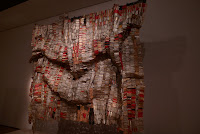
As the viewer walks into the African art room directly in front of the entrance is El Anstsui sculpture, Man's Cloth. Born in 1944, Anstsui is famous as being one of Afric'a foremost contemporary artists. He is a Ghanaian sculptor but is now based in Nigeria where he works as an educator for Africa's new talent, Head of Sculpture in the Department of Fine and Applied Arts, at the University of Nigeria, Nsukka. To display his work to every visitor can see it is not only helping establish Africa's contempoary movement but it is also refreshing everyones sterotypical view on what African art should look like.

El Anatsui used many different materials. In this he is working with recycled discarded foil bottle neck wrappers. The piece is a sculpture of the traditional Ghana made, narrow-strip ,woven silk. A strong representation of national pride. He has chosen to work with recycled materials to addresses the erosion of cultural values and inherited traditions through unchecked consumerism and continued transmission. His work is ultimately optimistic, though, indicating the dynamism and strength of tradition.

Providing a cultural reference

Tree of Life

Cristovao Canhavato

Hilario Nhatugueja

Fiel dos Santos

Adelino Serafim MatéMaputo

Mozambique, 2004

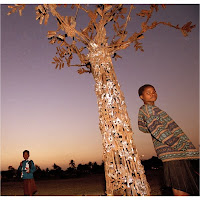
The sculpture as a memorial, is an example of how African people in the UK can benifit from the museum.

The Tree of Life is a colaboration project between four Mozambican artists: Cristovao Canhavato (Kester), Hilario Nhatugueja, Fiel dos Santos and Adelino Serafim Maté. Supported by Christian aid, it stemed from the Transforming Arms into Tools (TAE) project, which was set up in 1995 by Bishop Dom Dinis Sengulane. It related to the 1976 to 1995 Mozambique civil war which left millions of guns remaining hidden or buried around the country. Te project was an attempt to get the weapons decommissioned to resolve their threat. Mozambicans were encouraged to hand weapons over in exchange for items like ploughs, bicycles and sewing machines. The weapons were then cut up and turned into sculptures like the Tree of Life. The Tree of Life is a powerful memorial to war.

Explaining the Truth

Benin plaque

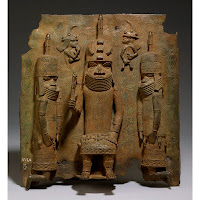
The oba with Europeans Benin, Nigeria, Edo peoples, 16th century AD

This plaque has the figure of the Oba in the centre. The Oba, direct descendant of Oranmiyan, the legendary founder of the dynasty, was the spiritual, secular and ritual head of the kingdom. He retained control over the major export resources (ivory, slaves, gum and palm kernels) and over trade between the kingdom and Europeans. The Art was an important instrument of ideology and the Oba controlled the artistic production of the palace craftsmen.

The Plaque above shows the Oba dressed in a loin-cloth with a plaited border and a close-fitting, sleeved upper garment, covered with cylindrical beads. He is accompanied by two attendants, as well as representations of long-haired Europeans which are shown either side of his head. Showing the ruler flanked by two attendants is a typical pictorial composition of brass and ivory works from Benin. The composition can therefore be seen as referring to the weight of office and to the responsibility of the people to assist their ruler.

There are over 900 plaques of this type in various museums in England, Europe and America. The bronzes in the British Museum were seized as booty in a punitive British army raid. The royal palace and stores were ransacked: some of the bronzes still show scorch marks from being wrenched from pillars in the burning palace. What is important about the display of the Bronzes is that the British Museum do not try to justify the Briish actions or hide them, instead they openly tell the story on a plaque for everyone to read: "Most of them were taken from the palace during the British Punitive Expedition in 1897."

They are thought to have been made in matching pairs and fixed to pillars in the Oba's palace in Benin City. It was discovered that the museum have been disrespectful and disregarding in the care of the objects, when in 2002 The British Museum addmitted to selling 30 pieces of Benin bronze in the 1950s and 1960s because they were considered Duplicates instead of part of a pair. Link to Guiardian article.

This raises the exsisting and still current debate as to who should have ownership of the placues. Idealy, if known to have been wrongly taken, the museum should return artifacts. However, having looked after and cared for, for so long, the objects now considered of worth: financially, historically and culturally. Musuems tend to be selfish and want to be sure the objects will go somewhere where they will be: safe, undamaged; not stolen by looters; distroyed by the owners in cultural riturals; sold on or lost because of political unrest; in an exchange where they aren't given to any fraudsters. It is an uneasy subject one that will eventually have to be resolved.

Monday, 3 January 2011

Designer Analysis - Sgro, Donna & Teijin

Sgro, Donna

Donna Sgro is a young designer working in Australia controling her own independent, boutique womenswear label called Donna Sgro. Her achievements include: (as part of the 1st Shinmai Creator’s Project) showcasing at Japan Fashion Week in Tokyo in 2009, exhibiting in Paris and is now part of Trash Fashion at the London Science Museum. Sgro's work is interesting because of her own interests, textiles place side by side with the latest technologies and production methods with playful colour combinations.


Sgro, Donna & Teijin
Trick of the light
Donna Sgro has designed the dress, titled trick of the light (shown above,) with a 1940's retro style ( an example shown to the right on the cover of a 1940's dress pattern.) The features include: a tailored cut; high wasted design pleated as if contained by a belt; a round neck created by two shown and emphasised pattern pieces; buttoned from top to bottom down the front seam; sleeveless arms, but with small ruffled cuffs on the shoulders; a respectable length sitting just over the knee; all neatly finished. The style has a modern womanly feel revolutionised by a post-war society where woman were now regarded as more independent, sophisticated and ready to work.

The dress material and style has no pattern motifs or accessories allowing focus to fall on the unique qualities of the material itself. A unique surface which can be described as the following: modern, reflective, heavy, shimmery, new. From afar the colour would resemble a grey but with the technology involved with it's production and the finish it gives grey as a description is far from the truth of the attractive aesthetic.


Inspiration to design the textile was in the question: How does a peacock’s feather or a butterfly’s wing create vivid displays of iridescent colour? The answer to both creatures is without dyes.


The textile industry is one of the most chemically intensive industries on earth, and is the No. 1 polluter of clean water (after agriculture). The problem is the amount of clean water needed in the production processes for example it takes about 500 gallons of water to produce enough fabric to cover one sofa. This water then pollutes as it leaves the majority of factories because of the effluent’s heat or the increased pH as well as this the water becomes full of chemical saturated with dyes, de-foamers, bleaches, detergents, optical brighteners, equalizers
additives to name a few, all of which help damage the environment. The developments in science that offer opportunities to produce colour without dyes could effectively have a major positive impact in the environment. As well as this the new material unlike your dyed clothes this colour won’t fade providing a higher quality more durable product, traits desirable in sustainable products.

This shimmering dress is made from a material called Morphotex, produced by the Japanese textiles company Teijin. An overview of the concept can be described as a material that mimics creations in nature by using just a trick of the light rather than an added dye. More specifically nanotechnology is used to create an iridescent effect – known as ‘structural colour’. The vibrant blue of the morpho butterfly is made into a template as the microscopic structure of its wings was recorded. Teijin uses 61 ultra-thin alternating layers of polyester and nylon to create each Morphotex fibre. By making each layer a precise thickness between 70 and 100 nanometres it’s possible to control the way light bounces, bends and scatters inside the fabric. This creates four basic colours (red, green, blue and violet) that reveal a rainbow of shades as light plays off the fabric.

Apart from Morphex there is a whole stream of technologies developing from natural designs with the same ideas of developments in mind including a team at Cambridge University who have recreated the bright flickering colour of opal gemstones, explained by Snoswell:
‘Previous man-made opals have been delicate and brittle. We’ve replaced the perfectly stacked glass spheres in opal’s structure with tiny plastic ones to create a new “copycat” opal that’s really durable and elastic. It opens up exciting possibilities to create new effects in fabrics.' David Snoswell, a nano-colour expert at Cambridge University.

Withing the Trash Fashion exhibition the descriptive comments summarise by talking about the technologies future: " There is huge potential to produce clothes by using this colour-changing material. In the next few years it could give an entirely fresh look to clothing " Science Museum

"... It’s possible to create subtle highlights, but we could also see swimsuits that make the wearer look like a tropical fish!"' David Snoswell

The summary specialises on a specific couture idea of a swimsuit. I think this prediction is ideal for the technology as finding the resources and capital to produce textiles at a Nano sized level for a mass market, I believe, would be near impossible but the fact companies are investing into sustainable ideas is progressive and even more so that designers like Donna Sgro are getting to use the materials in there designs, raising awareness and providing a muse to young emerging designers or fashion enthusiasts.

Summary of the Product:

Advantages:


Economical:
  • The new material would provide a dramatic selling point to boost the sales of a garment.

  • No dye manufacturing costs.

  • Reduced pollution costs (clean up etc)

Environmental:


  • Having no dyes reduces the pollution caused by production.

Ethical:


  • Aesthetically pleasing to an extent

Disadvantages:

Economical

  • Higher price to produce the material, including materials, labour ect

  • Material may be limited during other processes

  • Combination of materials may make it difficult to recycle

  • The fact the material is a new technology may either reduce or produce clients this can not be decided until it has integrated fully into the market

Environmental


  • Only cuts out one environmental problem, still many to face.

  • Heavy manufacturing process of the material may cause other environmental damages.

Ethical


  • High prices will limit and select the target market

Designer Analysis - Goldsworthy, kate

Goldsworthy, Kate

Kate Goldsworthy is a British textile designer and researcher working withing the TED research cluster based at Chelsea Collage of Art , passionate about sustainability and moving the fashion and textile industry forward, developing with ecology in mind. So far Kate has made an impression by developing the recycling and reuse of polyesters, young in her career, it is predicted that Goldsworthy and her predecessors will create a dramatic influence in the world of design.
As a textile artist she would be considered a modern entry into the movement of Environmental art, which deprived in the late 1960s as awareness of human destruction to the planet became more spread. The art can be considered in two different contexts relating to ecological issues or the natural, both involve addressing social and political even historical issues. However Kate has taken a more productive approach with her artistic abilities and is working as an active designer, with the philosophy of designing bjects and services to comply with principles of economic, social and ecological sustainability.
The intention of sustainable design is to work skillfully and sentitively towards eliminating negative environmental imact. It is a growing theme amunst designers, a reaction to the global environmental crises, rapid population growth and activity, depletion of natural resources, damage to ecosystems and loss of biodiversity. Ideals of Sustainable design include:
use of re-newable enegy sources, low energy material, non-toxic, recycled, sustainably prodced materials, efficient energy manufacturing processes, low energy requirments for products, high quality, durable, designed with a second life concept in mind, designed with a recycling pathway in mind, Low carban footprint.

The most innitive way of achieving sustainable design is upcycling, creating new products from old waste, designing with a second life inmind. The concept believes that one person's waste (e.g.industry bi-products) can be anothers fuel, it just requires the right design processes and technology. This will reduce the amount of waste going into landfil and the demand for raw materials, or even effectivly use new sustainable materials and production techniques.

Goldsworthy focus is based on the concept of life-cycle design or upcycling, she values design aestetics as well as fuctional uses of synthetics materials, designing with monomaterials suitable for upcycling.

Hot look
Goldsworthy, Kate
with thanks to: Textiles Environment Design,Chelsea Collage of Art & Design;Teijin Fibers; TWI Ltd and The Materials KTN

The dress is a simple elegant cut which draws to the focus of it's pattern. Traditional ornament flowers traditionally seen on 19th century wallpaper designs. The dress is entirely black except for a lilac blue sleeveless overlay cropped above the mid drift.
The pattern is created through cuts Rather then colour producing an interesting surface that is unique to the industry. These cuts as described are produced , more specifically, by laser beams used to slice, almost ‘stitch’ and pattern this intricate shift dress. The Lazor technology is called ClearWeld, and was developed at The Welding Institute in Cambridge. The process is explained: ‘Firstly, a programmed robotic arm applies an “absorber” liquid to the fabric to outline the pattern ... Then a low-energy laser beam travels over the material – it leaves some areas unaffected, but the sprayed areas melt because they absorb more laser energy.’ Ian Jones
A limited technique in terms of pattern design in comparison to current processing in the fashion industry however for Goldsworthy it's limitations are being extended as she works on new and exciting ways to push it's boundaries.
The only material used is 100% recycled polyester. This is the key factor in relation to it's value as a sustainable design. Having used only the single recycled materials the design firstly removes what was considered waste from landfills. a second factor is that when the product is at the end of it's life it pure and thus potential easily recycled again. The processes is working towards a closed loop concept and an example of upcycling.
Traditionally all clothing materials were made locally, naturally from animal and plant sources, when there life cycle was over they would decompose and naturally be recycled through the seasons . Now however thousands of materials are used from both natural and synthetic sources, normally a combination of the both, to achieve the demands from our ever growing population. The hybrids and our lack of understanding, or technology to separate, means now most of the materials end up in landfill, or any recycled materials produced are a monstrous and have few properties desired to fulfill a second life cycle. Human demands are so high that they can not be met if society took a step backwards to using traditional techniques and only natural resources.
Polyester clothing is made out of oil, a non-renewable resource that is running out. Like most plastics, polyester is difficult to dispose of because it takes so long to break down. This is seen as a disadvantage as most designs using polyester have a short lifeline with no upcycling future, the resource then gets wasted, its thrown into landfill polluting and occupying valuable space. However if we isolated the valuable non-renewable resources and designed products with second life cycles then the description can be seen as a advantage providing durability and quality.
The pure material is easy to recycle, Goldsworthy has teamed up with Japanese textiles company Teijin. They have developed a new chemical recycling process for polyester fibre to make it good as new. This means polyester could become infinitely recyclable, opening up exciting possibilities for the future of manufacturing. The technical advancement closes the life cycle of the dress and is a key factor in it's credibility.
Rather then a traditional step back it is the step forward to use synthetic materials in a closed loop system that needs to be initialised. Goldsworthy is one of the few examples that is providing a stepping stone to this new industrial revolution.
The next step would be then to integrate this type of technology amongst the existing manufacturers. Goldsworth describes this process as a responsibility for both manufacturers and designers:
'Yes, large companies need to figure out how to collect and sort old, unwanted clothes to reuse or recycle. But at the moment it’s very, very hard because so many different material types are all mixed together. So it comes back to designers – we really need to think ahead and design clothes that are easy to recycle.’ ... ‘Designers have an important role to play to make clothes fully recyclable in the future,’
Goldsworthy
The dress was showcased within the Science museums exhibition Trash Fashion and the notes they conclude with discuss the products future:
'The future is local... large companies could operate local hubs where people bring their old clothes to be chemically recycled into fresh polyester fibres. New digital manufacturing methods would enable new clothes to be made individually and on demand at the same site, which would massively reduce material waste and transportation costs.' Science museum
The talk of big companies almost diving to cater locally seems like an idealistic utopia idea a unrealistic summary,which I personally think could only be achieved by communist methods or a strict set of new laws from our government, unlikely because of there short lived elected political lives. It is so far from the mannerisms of our competitive, commercialised way of life; I feel it gives goldsworths progressive designs an undeserved fable covering but Kate herself agrees with the prediction:
‘I think these emerging technologies are really exciting. We could see the textiles and clothing industry return to being more local and much less wasteful.’ Goldsworthy
The project explores technologies that could potentially change the way we recycle our textile waste. I just hope that, in the future, the designs hold as much commercial potential as they do ecological.
Summary of the Product:

Advantages:

Economical?
  • Developing pattern making on one material increases the diversity of the product increasing the market for sales.
  • Laser cutters are already used in the industry to cut the cloth so only the costs of the other laser, ClearWeld, are needed.
  • Having a closed loop product could reduce the material costs if the clothes were collected at the end of their life span.

Environmental?

  • Closed loop system. The material can be upcycled because no other materials are combined with it to produce the garment.
  • No harmful chemical finishes

Ethical?

  • no chemicals mean no secondary effects e.g. water posioning

Disadvantages

Economical?

  • Machinery costs both with the initial process and the energy costs will be high.
  • Complexity of machinery will require trained technicians
  • In terms of time it looks as if the technology needs to be developed much more before the machinery can produce the numbers needed to make a profit.
Environmental?
  • Is limiting our clothing to one material type a sensible idea.

Ethical?

  • High machinery costs may have an effect on prices isolating the cheaper end of the market
  • Is the machinery safe to work with?
  • Will wearing only polyester be beneficial to the skin?
  • What are the limitations of the material, Is it practical for everyday use? Is it safe? Static, fire resistant ect?
  • Limits people who are allergic.
  • Comfort restrictions

Exhibition - Science Museum - Trash Fashion:Designing out Waste

Trash Fashion: Designing out waste

Antenna Gallery, Science Museum, LondonSW7 2DD

www.sciencemuseum.org.uk/trashfashion

http://antenna.sciencemuseum.org.uk/trashfashion/

Britain loves high-street fashion. Tempted by rock-bottom prices we’re buying a third more clothing than we did a decade ago. New looks on the catwalk and cut-price competition in the high street mean greater turnover – but more than a million tonnes of textiles end up in landfill each year. Dyes run, polymers break down and toxic chemicals ooze into the environment.

The new exhibition investigates how the latest design and technology will help to create wear without waste and what we can do to reduce the impact of throwaway fashion.

How can the latest design and technology help to create wear without waste? And what can we all do to reduce the impact of throwaway fashion?

---------------------------------------------------------------------------------------------

To dye for

That flash of high-fashion colour has a dark side. Dyes and finishes cast fashion’s largest environmental shadow – more than 70 toxic chemicals are flushed into the world’s water systems. Many will stay in the water cycle for ever.

How can technology light up a look and cut the chemical runoff?

Source: Kate Goldsworthy, Central Saint Martins College of Art & Design, with thanks to Textiles Environment Design, Chelsea College of Art & Design; Teijin Fibers; TWI Ltd and The Materials KTN

Powerful laser beams were used to cut, join and decorate this polyester shift dress. The laser-melted fabric provides its own finish, keeping it pure and free from chemical coatings. This makes recycling the material much simpler.

Source: Donna Sgro

Some designs make colour without any dye. This one reflects light to create the shimmer of a butterfly’s wing. An innovative fabric called Morphotex mimics a technology fashioned by evolution, and copies the nano-scale structure of the cobalt-blue wings of the morpho butterfly. No dyes are used in the dress – or the butterfly.

Source: DyeCat Ltd (fibre), Elizabeth Gaston (dress designer)

Normal dyes soak into the fibres. The brilliant black tint in this dress is cleverly bonded to the raw plastic that the synthetic fabric is made from. So no dyes contaminate the water, less water and energy are used, and there’s no chance that colour will run in the wash!
---------------------------------------------------------------------------------------------
Material desires
The average household contributes 26 items of wearable clothing to landfill every year. Polyester and other synthetics can take centuries to degrade. Natural fibres decay faster, but as they break down they release climate-altering methane and toxic dyes into the environment.

Can technology work with nature to make better fabrics that are easy to recycle and quick to break down?

Stinging Style

Source: Textile Engineering and Materials (TEAM) Research Group, De Montfort University

With a little ingenuity, stinging nettle fibres can be turned into clothes as soft as cotton – but stronger. Nettles are native to the UK and need little water or chemicals to grow, making them soft on the environment too.

Sugar Rush
Source: David Andersen, Danish Fashion Institute, featuring fabrics from the CLASS (Creativity, Lifestyle and Sustainable Synergy) eco library, www.c-l-a-s-s.org

The transparent layers in the skirt are little more than candyfloss. They are fashioned from Ingeo®, a ‘bioplastic’ produced from plant sugar. The rest of the dress is made of organic cotton. Unlike oil, the source of most synthetic materials, Ingeo® is fully compostable and will break down rapidly in the right conditions.

Source: Suzanne Lee, Central Saint Martins College of Art & Design

Is this jacket just your cup of tea? It’s fashioned from sheets of sugary ‘biofilm’ produced by the microbes that ferment green tea. The fabric was grown in bathtubs, dried and then moulded to fit. When it wears out it can go straight to the compost heap.
---------------------------------------------------------------------------------------------
Cut it out

Transforming cloth into a killer cut is a wasteful art. Fashion designers leave 15% of the fabric on the cutting-room floor. These ‘offcuts’ end up stuffed into cushions or languishing in landfill.
How can clever design keep razor-sharp lines and create cloud-like ruffles without adding to the scrapheap?

Knit to Fit
Source: Sandy Black, Centre for Fashion Science, London College of Fashion, UAL

This nifty knit was made as one seamless piece based on individual measurements made in a 3D body scanner. An electronic eye could replace the tailor’s tape measure and make precision-customised clothing affordable for all.

Made to measure
Source: Siddhartha Upadhyaya, August Fashions

This jacket was produced in a unique process called Direct Panel on Loom (DPOL). This weaves made-to-fit sections of the garment and dramatically reduces the materials and dyes used. The sections include design detail and are simply stitched together.


Keep Trim
Source: Mark Liu Unicorn Collection

Just one sheet of cloth is cut into jigsaw-like pieces that fit seamlessly together to form this intricate catwalk creation. Every inch of fabric is used in the process: there’s no waste.


Cocktail frock
Source: Berber Soepboer/Refinity: eco-effective design
Fed up with your old look? The sections of this skirt ‘click and fold’ into place and can be mixed in new ways to create an appetising variety of styles and colour. There are no stitches or zips, so recycling is easy. And because the dyes are not toxic the woollen flannel would actually be safe enough to eat. Source: Berber Soepboer/Refinity: eco-effective design

-----------------------------------------------------------------------------------------------


Digital Print

Off the cuff
Source: Rebecca Earley and Frances Geesin, Textiles Environment Design, Chelsea College of Art & Design
Chic new designs have been transfer-printed to add flair to a dull old polyester shirt. Designers borrowed a vintage idea and added detachable collar and cuffs – made of worn polyester lace electroplated with silver. These intricate pieces can double as jewellery when the shirt finally goes for recycling.


Out of print
Source: Melanie Bowles and Kathy Round, Textiles Environment Design, Chelsea College of Art & Design

Old textiles get a new look with digitally printed design. The delicate patterns on this recycled silk dress are inspired by vintage motifs from a worn-out silk gown, extending the life of a favourite frock. The new pattern pieces were printed to order – this cuts down on cloth and chemicals.


---------------------------------------------------------------------------------------------


Raising Awearness

Daily Fashion
Source: Yuliya Kyrpo/Science Museum

Ever worn a dress once and then thrown it away? This fabulous frock is made of old Metro newspapers carefully folded into a thousand origami cranes. Consider it a headline-hitting comment on throwaway fashion.


Drop-dead dress
Source: Pia Interlandi, Royal Melbourne Institute of Technology in conjunction with SymbioticA and the Centre for Forensic Science, The University of Western Australia

After 50 days underground, this dress vividly shows how different materials degrade over time. Bacteria in the soil have eaten up the hemp into the seams, but the polyester cord and embroidery look as good as new. (Note – this is not an accurate representation of landfill conditions)

Sunday, 2 January 2011

Material Analysis - Woolen Felt


Material: 100% Wool Felt

Other Types: blended, synthetic
Named Types:
Loden

Aesthetics description:
A non-woven cloth. While some types of felt are very soft, some are tough enough to form construction materials. Felt can be of any colour, and made into any shape or size
Source: Sheep

Production: A process called wet felting involving: matting, condensing and pressing woolen fibres. Explained below:
  • wool fibre is stimulated by friction
  • lubricated by moisture (usually soapy water)
  • fibres move at a 90 degree angle towards the friction source and then away again, making little "tacking" stitches
  • few fibres are active at any one moment therefore the process is continual; different 'sets' of fibres become activated and then deactivated in the continual process.
  • Wool and animal hairs have scales on them which are directional and have kinks (similar to a pine cone) this reacts to the stimulation of friction and bond together to form a cloth.
Various other techniques include:
  • Needle felting- art craft, no water, barbed felting needles are used as a sculpting tool. The barbs catch the scales on the fibre and push them through the layers of wool, tangling them and binding them together. Fine detail can be achieved.
  • Carroting- Mid 17th - 20th centery process, now banned (Dec 1941), used to manufacture felt for mens hats. Beaver, rabbit or hare skins were treated with a dilute solution of the mercury compound mercuric nitrate. The skins dried in an oven, (thin fur at the sides go orange) Pelts were stretched over a bar in a cutting machine and the skin sliced off in thin shreds, the fleece removed entirely. The fur, blown onto a cone-shaped colander, treated with hot water to consolidate it, the cone peeled off and passed through wet rollers to cause the fur to felt. These 'hoods' were then dyed and blocked to make hats. This toxic solution and the vapours it produced resulted in widespread cases of mercury poisoning among hatters, giving rise to the expression "mad as a hatter."
  • Fulling- Fulling is done to fabric whereas felting is done to fibres. Fibres bond together when combined with the movement of a washing machine, the heat of the water, and the addition of soap, e.g. Knitted woollen garments which shrink in the machine achieveing a felt quality
  • Steam rolling- A steam roller goes over the unwoven fabrics in a shallow pool of water with the cloths rotate. A method widely used in small towns in India where mass manufacturing of clothing is done.

Common uses:
bearing seals
polishing pads
wiper Lubricators
Advantages:
  • highly resilient,
  • retains its strength
  • chemical resistant
  • flame retardant and self-extinguishing
  • wear resistant
  • cuts with a clean edge
  • does not ravel or fray
  • easily cut (any size, shape or thickness)
  • can be hard enough to turn on a lathe or soft enough to be sewn
  • can be exposed to the elements
  • maintains its physical properties as it wears, making it an excellent choice for polishing
  • Felt is incredibly resilient, able to be compressed and released thousands of times without deformity
  • sound insulator
  • vibration damping qualities
  • thermal insulator
  • wicking capabilities delivering consistent fluid flow without deterioration
  • highly absorbent
  • can retain many times its weight in fluids
  • Felt can be made water repellent
  • arguable renewable and a environmentally friendly resource

Friday, 5 November 2010

Rough Guide


Rough Guide

1) Chosen Object from a market stall or second hand Shop or found object from the area you are exploring for the rough guide.
2) Chosen object from a department store or boutique
3) Chosen object from an art gallery or museum

Presentation is a key aspect when considering sales. An objects location will have a dramatic affect on its context and the publics view. I have selected three objects all presenting a sunflower theme, the main difference between the three is how and where they are displayed.
The first object selected is a piece of jewellery found for sale within Covent Garden Market. It is a pair of cufflinks that feature a sewn sunflower head. They retail at around £15.00 a pair, cash only.
The second object is a Multicoloured Flower Cushion, by Bluebell Grey, it retails at the price of £120.00. The Secret garden cushion, featuring a sunflower, has pompoms which are hand-painted in the UK, and described by the seller as “to be intended to be treasured and loved.”
The object I have chosen from an Art Gallery is a painting by Vincent van Gogh, 1888 called Sunflowers as seen below. It is displayed in London’s National Gallery. It is worth around £25 million.
Market stalls are normally small temporary constructions with changing stock, the idea is to make quick sales as storage isn’t necessarily available and the produce normally changes depending on seasonal and fashion adjustments our society makes. Advertisements are normally eye grabbing to attract people walking past, the main source of customer: impulse buyers. The stalls have low overheads, normally self run and employing only a few staff. A customer can therefore get cheaper readily available items. The atmostsphere is busy, lively and loud.
Department stores in comparison to a market stall are at the complete opposite scale. They base their environments on the layout similar of a gallery. A lot of money will have been invested into architectural developments for the original building and the interiors will have been professionally designed to promote the products: often on a large scale, organised, neat, tidy, clean and white. White floors, ceilings and walls give the rooms a spacious feel that echoes that of a gallery. Day to day overheads will be a lot higher, money spent on electricity for lighting displays, elevators, checkouts etc. and the staff wage will be higher (lowering the staff -customer ratios) and background staff involved in human resources, sales and security will be employed. All of this upheaval is to create a higher class style of shopping for those considered to be wealthier who can afford to enjoy such an experience. By making the shop more of a day out at an expensive overhead, the products will have a higher in price to cover the costs. It is these higher floor prices that will then restrict the lower paid society, making the whole experience exclusive.
The National Art galleries in London are in grand, expensive, architecturally designed, and internally modified buildings, often historical and listed as a mark for location reference. Security is high and a large number of staff is used to watch and assist the guests. The rooms are very large especially the height of the ceilings and door frames. The work in relation to the cost of the experience is given a over generous amount of space. The lighting is adjusted in relation to the works and each piece has a description clearly and professionally mounted adjacent. The atmostsphere is silent. When you’re in the room you are very much aware that the art work is the centre of focus. Galleries are normally free and accessible to everyone because the art is not for sale over the counter the purpose of the site is to simply appreciate and admire the work and artists which is believed to be within everyone capacity. However on entry into the building there is a set of rules which you must follow.
If you moved the objects between locations they would defiantly change in value. It is believed that Van Gogh only sold one of his paintings during his life time probably on a site similar to that of a market stall at a price suitable for the venue; however now placed in the gallery its worth has reached an unseemly high amount. In relation to this physical movement between market stall to gallery, it is worth mentioning that quiet often there is a debate between art enthusiasts that discuss the imperial value of modern art. Often the works can be as simplistic as a mundane object available by mass production. Yet within the gallery environment these originally plain objects can reach prices of again a substantial amount simply because of the belief that the artists are making an expression or opinion and the environment from which this can be admired.
A products movement between market stall to department store is less extreme then that of a gallery however there is still much debate and discussion about the selected items that make the cut. A buyer is specifically employed to have this debate. With higher prices the customers of the department store consciously ask if the added costs are justifiable. Generally the usual cliental do not mine paying more is the product is more exclusive, better made: materially, environmentally and ethically, if it is considered fashionable or well crafted with time and skills. The chosen cushion example ticks all of the specific criteria; I feel that for a product to make the move into a department it must also have raised standards.
Quite often copies of department store objects appear on market stalls, they are normally of a lower quality but they get sold because they mimic the enthusiasm and styles of the fashionable yet they are affordable. With this common ownership the departments then have to move forward and eject a new range to keep their standards of providing the more exclusive and more fashionable objects.
In conclusion the three objects and their environments main different is because of the presentation and the associated costs to provide the different levels of service. Theses costs then remain in the cycle as an additional overhead reflected in the products price. The public view the objects material value by the literal cost. But then question their investments and silently demand additional manufacturing quality and exclusivity for the greater costs. I think that all three levels of presentation work well to promote sales for each other by chasing the competitive need to be the most fashionable. Galleries set the standard of art by displaying one off selected works considered superior. Department stores then work with designers to echo this quality but cater for the mass produced. Market stores eventually provide a close interpretation of the fashioned item but at an affordable price. Which then re-sets the cycle because when everyone owns a fashion statement it can not longer be considered a one-off so gallery works change (to an extent) or more realistically the department stores have to search or design new ways to be exclusive or take inspiration from different displays at the galleries. A cycle that looks, in modern society, to be unbreakable.