Showing posts with label Exhibition Reviews. Show all posts

Saturday, 29 January 2011

Royal Academy Visit – Art, Fashion, Identity

Everything below was directly copied from the following website: http://www.royalacademy.org.uk


Royal Academy

6 Burlington Gardens, Royal Academy of Arts, London, W1S 3ET

AWARE: ART, FASHION, IDENTITY
‘The third season of contemporary art at 6 Burlington Gardens examines how artists and designers use clothing as a mechanism to communicate and reveal elements of our identity.’

"The exhibition examines how artists and designers use clothing as a mechanism to communicate and reveal elements of our identity. The exhibition includes work by 30 leading international practitioners and is divided into four sections: Storytelling , Building , Belonging and confronting , Performance

Story Telling
Grayson PerryArtist's Robe, 2004

This grand and elaborate robe combines historical references to the traditional kimono and the notion of clothing as an indicator of learning. It also refers to the uniforms associated with societies, clubs or academies, while commenting on the position and perception of the artist in contemporary society. The eye connotes wisdom and the artist’s role as an interrogator of the visual world.

Susie MacMurrayWidow, 2009

The elegance and feminine beauty of this dress is seductive, but on closer examination the aggression of its form becomes clear. Pins have strong associations with female craft, as well as connotations of pain. The leather replaces traditional dress fabric and represents skin, which is both sensitive and protective. Based on the human (and in this case female) reaction to grief, the work articulates the isolation that such an experience can bring about, how such extreme emotion can cause someone to repel the empathy or intimacy of others.

Helen StoreySay Goodbye, 2010
Formerly a fashion designer, Storey has more recently investigated how science, art and fashion might come together in leading the way for a more sustainable future.
These dresses form part of her research into biodegradable materials: the enzyme-based textile will dissolve over time as it comes into contact with water. They also comment on contemporary society’s desire for a plentiful supply of clothing.

Building

Building covers the concept of clothing being used as a form of protection and the notion of carrying one’s own shelter, referencing the nomadic, portable nature of modern life. On display is Shelter Me 1, 2005 by Mella Jaarsma who in her work parallels garment and architectural constructions. Jaarsma defines shelter as the minimal construction needed for protection, not yet the shape of a house, but directly related to the proportions of the human body.

Works in this section include:

Mella JaarsmaShelter Me 1, 2005
Born in Holland and now based in Indonesia, Jaarsma is interested in the process of adapting to the lifestyle and traditions of a new environment. This sculptural and mobile protective covering reflects the culture of the place in which it was made, the temple shape referring to the religious architecture of Yogyakarta. The refuge raises questions about migration and highlights two symbols of individual and social identity – clothing and habitat.

Azra Akšamija Nomadic Mosque, 2005
Acknowledging the need for flexibility in modern life, Akšamija has created a piece of wearable architecture. This private, mobile mosque redefines traditional places of worship for a contemporary context, and allows the individual the freedom to worship in any environment.
Watch related video


Yohji YamamotoFrom the Yohji Yamamoto Femme Collection, Autumn/Winter 1991–92
The fashion designer Yohji Yamamoto has clearly articulated his position on the industry in which he works – he dislikes fashion and feels that his role is to regain respect for clothing and promote women’s independence. In this seminal piece, a wooden framework is moulded into the form of a dress, suggesting a human skeleton, an architectural structure and armour. While in shape it recalls the constraining corsets that women used to wear, its robust appearance also asserts the strength of the person that might wear it. In Yamamoto’s hands a prosaic material becomes an unlikely adornment.
Belonging and Confronting

Belonging and Confronting examines ideas of nationality as well as displacement and political and social confrontation, recognizing the tensions associated with the assimilation of new cultures and traditions. In Palestinian artist Sharif Waked’s video installation, Chic Point, 2003, the contradictory interpretations of revealing flesh as a fashion prerogative or as a humiliation juxtapose two worlds, one of high fashion and the other of semi-imprisonment.

Works in this section include:


Sharif WakedChic Point, 2003
In much of his work the Palestinian artist Sharif Waked confronts the difficulties faced by his people and the complexities of the political situation in the Middle East. In these video works, clothes designed to reveal areas of fleshare seen alongside images of Palestinian men being subjected to body searches at Israeli checkpoints. Playing on the glamour of the catwalk, Waked uses the sense of identity and dignity associated with clothing to make a powerful political comment about its removal.


Yinka Shonibare MBELittle Rich Girls, 2010
In this piece, specially commissioned for the exhibition, Shonibare continues his exploration of postcolonial Africa. The wax-printed cotton batik fabric that is a feature of all his work is strongly associated with Africa, but in fact wasoriginally designed and printed in Holland and exported when it found no market in Europe. The installation of children’s clothes underlines cultural crossovers and the relationship between developing nations on the West. Dutch wax-printed cotton


Alicia Framis100 Ways to Wear a Flag, 2007
To create this work, Framis invited sixteen fashion designers to make dresses inspired by the Chinese flag. The proliferation of the garment export industry in modern China, an important factor in its burgeoning economy, is suggested. The associations of nationhood that the flag bears could both empower and burden the wearer of such dresses
Performance


The importance of Performance in the presentation of fashion and clothing, and in highlighting the roles that we play in our daily life, is explored in the final section. It features film footage of Yoko Ono’s performance of Cut Piece at Carnegie Recital Hall, New York in 1965, for which the artist invited the public to cut strips from her clothing. While the scraps of fabric fall to the floor, the unveiling of the female body suggests the total destruction of the barriers imposed by convention.

Works for this section include:

Yoko OnoCut Piece, 1965
Yoko Ono first performed this piece in Japan in 1964. She sits motionless on a stage while the public are invited to cut her clothing. Closely in tune with the second-wave feminist movement that began in the 1960s, the work explores women’s emancipation from constraints on their identity represented by clothing and encourages respect for the female body. Ultimately, it also suggests the value of nakedness as an expression of identity in its purest form.


Gillian WearingSixty Second Silence, 1996
This video piece examines the authority of clothing and the dynamic of the group. People dressed in police uniforms are arranged in the ranked pose of a formal photograph. As time elapses they start to fidget and the individuality of each participant emerges, diminishing the authority of their uniform, with all its associations of state and power.


Hussein Chalayan‘Son’ of Sonzai Suru, 2010
In this installation Chalayan uses Bunraku theatre, a traditional form of Japanese puppet theatre, to examine the manipulativeelement of the fashion industry. The beauty of the dress is evident, but the controlling figures around it invite us to consider how our perception of the value of fashion is managed by its presentation. The piece demonstrates Chalayan’s ease in bringing together different cultures and creative disciplines.

Tuesday, 4 January 2011

Exhibition - V&A - Diaghilev

Diaghilev exhibition at the V&A
notes and reflections ...
Serge DiaghilevAbout 1924

The Ballets Russes, Diaghilev finest creation, toured the world between 1909 and 1929. It continued through the hardships of the First World War and the Russian Revolutions. Cut off from their routes and where they had preformed before 1914, it was an amazing achievement that the productions continued. This achievement was because of Diaghilev.

Serge Pavlovich Diaghilev was born in 1872. He was known to have a unique character and driven ambition. He was an elusive man who seemed unaffected by the war or his countries political hardships; a patron to modernism, yet a deeply conservative person who lived mostly out of hotel rooms, and with only the companionships of his company who he treated as extended family. When he died in 1929 he left few possessions including a large collection of literature and a top hat.

Diaghilev had combined dance, music and art in bold ways to create "total theatre". He transformed even revolutionized the world of dance and theatre from the stuffy white tutu and embraced the modern and exploited the avant-garde to create exotic performances. His work is still inspiring and influencing the culture of today, an astonishing legacy of music dance and art.
Below are notes information taken from the V&A website discussing The Ballet Russes:

Ballets Russes dancers in an on-stage dance class1928

The First Seasons, 1909-14
On 19 May 1909, after weeks of publicity, Diaghilev launched his first season of Russian ballet in Paris. Audiences were dazzled by the dancing and striking designs. Over the next few seasons a self-consciously Russian element dominated the productions. Innovative music magnified their impact, in particular that of Igor Stravinsky. The company's principal choreographer was the Russian dancer Mikhail Fokine.

Visually, the first Ballets Russes seasons were marked by the exotic designs of the Russian-born artist Léon Bakst. His bejewelled colours, swirling Art Nouveau elements and sense of the erotic re-envisioned dance productions as total works of art.

Following his critical triumph in 1909, and despite a financial loss of 76,000 francs (over £350,000 today), Diaghilev was in demand across Europe. So in 1911 he established the Ballets Russes as a year-round touring operation rather than a seasonal enterprise.
Signed photograph of Vaslav Nijinsky in Le Spectre de la rosePhotograph by Bert1912
Nijinsky: A Force of Nature

The virtuosity and charisma of Vaslav Nijinsky (1889-1950) were such that no one who saw him perform, it was claimed, ever forgot him.
He transformed himself for each role he danced. Trained in the Russian Imperial Ballet, he was an instant success on the Parisian stage from the Ballets Russes' first season in 1909. Audiences had not seen an equivalent male dancer for more than two decades.

As a choreographer, he created unusually varied productions, whose style of movement differed radically from one another and from the academic ballet audiences were used to seeing.

Nijinsky became Diaghilev's lover in late 1908. It was an intense relationship in which Diaghilev was often seen to dominate, and abruptly halted when Nijinsky married and Diaghilev dismissed him from the company in 1913. He returned briefly for two seasons during the First World War, but later suffered from schizophrenia, which eventually ended his career.
Creating Ballet

Ballet uses the human body to express story and emotion. Given this basic character, ballet tends to explore strong simple stories which may also provide opportunities for dancers to display their virtuosity.

While the dances performed by the Ballets Russes appeared revolutionary, they drew on existing traditions of ballet production. As the driving force of the company, Diaghilev gathered a wide range of composers, choreographers, designers and performers, but maintained ultimate control over every aspect of the productions. His greatest achievement was to ensure the close integration of story, music, choreography and design, creating spectacles where the overall impact surpassed the parts.

From the start, Diaghilev's ambition was to generate entirely new ballets rather than repeat others' successes. Typically, each Ballets Russes season might include two or three new productions and their creation, often protracted, took up a large proportion of his time and energy.
The War Years
The First World War (1914-18) nearly destroyed the Ballets Russes. During the years of devastating warfare, Diaghilev was isolated from his main European venues. In 1914 Diaghilev and Stravinsky were successful citizens of imperial Russia. By 1918 they were stateless exiles from a Bolshevik Russia wracked by civil war.

When war broke out, the Ballets Russes had completed five successful years and were just dispersing for their summer vacation. The company did not reform until May 1915, when Diaghilev rebuilt it for the first North American tour.

The productions of 1915-19 were both the most conservative and most experimental. The Ballets Russes toured popular works to new audiences in North and South America. Yet there were long periods in Europe without performing, in which the company could workshop original ideas. Léonide Massine emerged as a talented new choreographer, drawing on influences from the countries of his travels, notably Italy and Spain.
Ballets Russes in the 1920s
The First World War saw the collapse of the Russian, German, Austro-Hungarian and Ottoman empires. After a brutal civil war, Russia came under Communist control and Diaghilev never returned. The belle époque that had seen the birth of the Ballets Russes had been shattered forever.

Diaghilev's great themes - Russia, the classical world and the Orient - were now treated in the context of modernity. Other ballets reflected topical interests such as beach culture, films and sport.

By 1920 the Ballets Russes had a considerable repertoire to which new ballets were added each year. French avant-garde artists such as Matisse, Derain and Braque designed productions, while the choreographers Massine, Nijinska and Balanchine approached movement in innovative ways.

Diaghilev and his company had to adjust to very different economic circumstances. Monte Carlo now provided a winter base in which to create new works, while long seasons in London provided some financial stability.
Legacy
The designs and colours used in Ballets Russes productions forged a new aesthetic in the 20th century. Knowledge of the company's revolutionary ballets filtered through to theatre, fashion and daily life, including interior design. Diaghilev's presentation of his homeland in particular created a notable strand of Russian style.

Perhaps the most evident legacy is the music Diaghilev commissioned. Ballet scores by Stravinsky, de Falla and others continue to be performed in concert halls around the world.

The repertoire of the Ballets Russes remains an invaluable resource for choreographers today. Over 200 different versions of The Rite of Spring have been choreographed since Diaghilev commissioned it. Diaghilev's achievements continue to inspire the worlds of art, theatre, music and dance.

British Museum - African art (Room24)

Africa (Room 25)

"The diverse cultural life of Africa has been expressed through everyday objects and unique works of art since ancient times. The Museum’s collection of over 200,000 African items encompasses archaeological and contemporary material from across the continent." The British Museum

  • From known associations with African Art; what is unusual about the Collection?
  • Who can use the museum? What is it's Purpose?
  • How does the exhibition portray the collection?

When you mention African art immediatly you picture the following connitations: emphasised human figures; visual abstractions (rarther then natural representations); the use of bright colours; an ephasis on sculpture and three dimential work e.g. wallhangings and decorative clothing; performance art: including crafted performance contexts masks and costumes; spiritual backgrounds; and nonlinear scaling or fractural gemoratry (where as part of the designs are larger, representing natural growth as opposed to pattern). These subjective overviews are true for the more traditional Africa.

Previously scholars and art collectors have been naieve with the presentation of African arts, displaying only the traditional examples and leaving out Africa great and thriving contemporay art culture.

Museums and galleries have shifted their views on what is important in curating a display, it is not longer just about getting dates and locations right or putting the most unusual objects at the front of the display. The audiences of museums have widened. Now a broader range of people are asking for the truth. For Room 24 it means sharing display space between traditional and contemporary designs to widern the opinions of African art as only availiable in the primitive (objects from africa hundreds of yesars old).

Britian, especially london, is a multi-cultural society, people from across the globe will use the British gallery as a source of information and education. The museum is using this as an opportunity to not only show examples of good designs and artwork, but to give people a chance to learn about their or their decendants cultures

In other museums rooms, the truth and thoughtful displays can mean: displaying objects respectivily (even taking objects down if they are disrespectful to traditions etc. e.g. pots symbolising the dead); hightlighting problems with ownership, making it clear how a object was exivatored even if it was unjust (enen if it means returning the object) and re-evaluating dates curators decided when propergander has an influence. Not all departments or other museums are as developmental as African Art Room 25.

Below are three examples of art work in room 25 , each an important example of good curatorship.

Introducing a broad range of Designs

El Anatsui

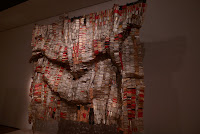
Man's Cloth

As the viewer walks into the African art room directly in front of the entrance is El Anstsui sculpture, Man's Cloth. Born in 1944, Anstsui is famous as being one of Afric'a foremost contemporary artists. He is a Ghanaian sculptor but is now based in Nigeria where he works as an educator for Africa's new talent, Head of Sculpture in the Department of Fine and Applied Arts, at the University of Nigeria, Nsukka. To display his work to every visitor can see it is not only helping establish Africa's contempoary movement but it is also refreshing everyones sterotypical view on what African art should look like.

El Anatsui used many different materials. In this he is working with recycled discarded foil bottle neck wrappers. The piece is a sculpture of the traditional Ghana made, narrow-strip ,woven silk. A strong representation of national pride. He has chosen to work with recycled materials to addresses the erosion of cultural values and inherited traditions through unchecked consumerism and continued transmission. His work is ultimately optimistic, though, indicating the dynamism and strength of tradition.

Providing a cultural reference

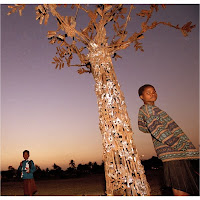
Tree of Life

Cristovao Canhavato

Hilario Nhatugueja

Fiel dos Santos

Adelino Serafim MatéMaputo

Mozambique, 2004

The sculpture as a memorial, is an example of how African people in the UK can benifit from the museum.

The Tree of Life is a colaboration project between four Mozambican artists: Cristovao Canhavato (Kester), Hilario Nhatugueja, Fiel dos Santos and Adelino Serafim Maté. Supported by Christian aid, it stemed from the Transforming Arms into Tools (TAE) project, which was set up in 1995 by Bishop Dom Dinis Sengulane. It related to the 1976 to 1995 Mozambique civil war which left millions of guns remaining hidden or buried around the country. Te project was an attempt to get the weapons decommissioned to resolve their threat. Mozambicans were encouraged to hand weapons over in exchange for items like ploughs, bicycles and sewing machines. The weapons were then cut up and turned into sculptures like the Tree of Life. The Tree of Life is a powerful memorial to war.

Explaining the Truth

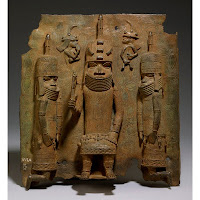
Benin plaque

The oba with Europeans Benin, Nigeria, Edo peoples, 16th century AD

This plaque has the figure of the Oba in the centre. The Oba, direct descendant of Oranmiyan, the legendary founder of the dynasty, was the spiritual, secular and ritual head of the kingdom. He retained control over the major export resources (ivory, slaves, gum and palm kernels) and over trade between the kingdom and Europeans. The Art was an important instrument of ideology and the Oba controlled the artistic production of the palace craftsmen.

The Plaque above shows the Oba dressed in a loin-cloth with a plaited border and a close-fitting, sleeved upper garment, covered with cylindrical beads. He is accompanied by two attendants, as well as representations of long-haired Europeans which are shown either side of his head. Showing the ruler flanked by two attendants is a typical pictorial composition of brass and ivory works from Benin. The composition can therefore be seen as referring to the weight of office and to the responsibility of the people to assist their ruler.

There are over 900 plaques of this type in various museums in England, Europe and America. The bronzes in the British Museum were seized as booty in a punitive British army raid. The royal palace and stores were ransacked: some of the bronzes still show scorch marks from being wrenched from pillars in the burning palace. What is important about the display of the Bronzes is that the British Museum do not try to justify the Briish actions or hide them, instead they openly tell the story on a plaque for everyone to read: "Most of them were taken from the palace during the British Punitive Expedition in 1897."

They are thought to have been made in matching pairs and fixed to pillars in the Oba's palace in Benin City. It was discovered that the museum have been disrespectful and disregarding in the care of the objects, when in 2002 The British Museum addmitted to selling 30 pieces of Benin bronze in the 1950s and 1960s because they were considered Duplicates instead of part of a pair. Link to Guiardian article.

This raises the exsisting and still current debate as to who should have ownership of the placues. Idealy, if known to have been wrongly taken, the museum should return artifacts. However, having looked after and cared for, for so long, the objects now considered of worth: financially, historically and culturally. Musuems tend to be selfish and want to be sure the objects will go somewhere where they will be: safe, undamaged; not stolen by looters; distroyed by the owners in cultural riturals; sold on or lost because of political unrest; in an exchange where they aren't given to any fraudsters. It is an uneasy subject one that will eventually have to be resolved.

Monday, 3 January 2011

Designer Analysis - Goldsworthy, kate

Goldsworthy, Kate

Kate Goldsworthy is a British textile designer and researcher working withing the TED research cluster based at Chelsea Collage of Art , passionate about sustainability and moving the fashion and textile industry forward, developing with ecology in mind. So far Kate has made an impression by developing the recycling and reuse of polyesters, young in her career, it is predicted that Goldsworthy and her predecessors will create a dramatic influence in the world of design.
As a textile artist she would be considered a modern entry into the movement of Environmental art, which deprived in the late 1960s as awareness of human destruction to the planet became more spread. The art can be considered in two different contexts relating to ecological issues or the natural, both involve addressing social and political even historical issues. However Kate has taken a more productive approach with her artistic abilities and is working as an active designer, with the philosophy of designing bjects and services to comply with principles of economic, social and ecological sustainability.
The intention of sustainable design is to work skillfully and sentitively towards eliminating negative environmental imact. It is a growing theme amunst designers, a reaction to the global environmental crises, rapid population growth and activity, depletion of natural resources, damage to ecosystems and loss of biodiversity. Ideals of Sustainable design include:
use of re-newable enegy sources, low energy material, non-toxic, recycled, sustainably prodced materials, efficient energy manufacturing processes, low energy requirments for products, high quality, durable, designed with a second life concept in mind, designed with a recycling pathway in mind, Low carban footprint.

The most innitive way of achieving sustainable design is upcycling, creating new products from old waste, designing with a second life inmind. The concept believes that one person's waste (e.g.industry bi-products) can be anothers fuel, it just requires the right design processes and technology. This will reduce the amount of waste going into landfil and the demand for raw materials, or even effectivly use new sustainable materials and production techniques.

Goldsworthy focus is based on the concept of life-cycle design or upcycling, she values design aestetics as well as fuctional uses of synthetics materials, designing with monomaterials suitable for upcycling.

Hot look
Goldsworthy, Kate
with thanks to: Textiles Environment Design,Chelsea Collage of Art & Design;Teijin Fibers; TWI Ltd and The Materials KTN

The dress is a simple elegant cut which draws to the focus of it's pattern. Traditional ornament flowers traditionally seen on 19th century wallpaper designs. The dress is entirely black except for a lilac blue sleeveless overlay cropped above the mid drift.
The pattern is created through cuts Rather then colour producing an interesting surface that is unique to the industry. These cuts as described are produced , more specifically, by laser beams used to slice, almost ‘stitch’ and pattern this intricate shift dress. The Lazor technology is called ClearWeld, and was developed at The Welding Institute in Cambridge. The process is explained: ‘Firstly, a programmed robotic arm applies an “absorber” liquid to the fabric to outline the pattern ... Then a low-energy laser beam travels over the material – it leaves some areas unaffected, but the sprayed areas melt because they absorb more laser energy.’ Ian Jones
A limited technique in terms of pattern design in comparison to current processing in the fashion industry however for Goldsworthy it's limitations are being extended as she works on new and exciting ways to push it's boundaries.
The only material used is 100% recycled polyester. This is the key factor in relation to it's value as a sustainable design. Having used only the single recycled materials the design firstly removes what was considered waste from landfills. a second factor is that when the product is at the end of it's life it pure and thus potential easily recycled again. The processes is working towards a closed loop concept and an example of upcycling.
Traditionally all clothing materials were made locally, naturally from animal and plant sources, when there life cycle was over they would decompose and naturally be recycled through the seasons . Now however thousands of materials are used from both natural and synthetic sources, normally a combination of the both, to achieve the demands from our ever growing population. The hybrids and our lack of understanding, or technology to separate, means now most of the materials end up in landfill, or any recycled materials produced are a monstrous and have few properties desired to fulfill a second life cycle. Human demands are so high that they can not be met if society took a step backwards to using traditional techniques and only natural resources.
Polyester clothing is made out of oil, a non-renewable resource that is running out. Like most plastics, polyester is difficult to dispose of because it takes so long to break down. This is seen as a disadvantage as most designs using polyester have a short lifeline with no upcycling future, the resource then gets wasted, its thrown into landfill polluting and occupying valuable space. However if we isolated the valuable non-renewable resources and designed products with second life cycles then the description can be seen as a advantage providing durability and quality.
The pure material is easy to recycle, Goldsworthy has teamed up with Japanese textiles company Teijin. They have developed a new chemical recycling process for polyester fibre to make it good as new. This means polyester could become infinitely recyclable, opening up exciting possibilities for the future of manufacturing. The technical advancement closes the life cycle of the dress and is a key factor in it's credibility.
Rather then a traditional step back it is the step forward to use synthetic materials in a closed loop system that needs to be initialised. Goldsworthy is one of the few examples that is providing a stepping stone to this new industrial revolution.
The next step would be then to integrate this type of technology amongst the existing manufacturers. Goldsworth describes this process as a responsibility for both manufacturers and designers:
'Yes, large companies need to figure out how to collect and sort old, unwanted clothes to reuse or recycle. But at the moment it’s very, very hard because so many different material types are all mixed together. So it comes back to designers – we really need to think ahead and design clothes that are easy to recycle.’ ... ‘Designers have an important role to play to make clothes fully recyclable in the future,’
Goldsworthy
The dress was showcased within the Science museums exhibition Trash Fashion and the notes they conclude with discuss the products future:
'The future is local... large companies could operate local hubs where people bring their old clothes to be chemically recycled into fresh polyester fibres. New digital manufacturing methods would enable new clothes to be made individually and on demand at the same site, which would massively reduce material waste and transportation costs.' Science museum
The talk of big companies almost diving to cater locally seems like an idealistic utopia idea a unrealistic summary,which I personally think could only be achieved by communist methods or a strict set of new laws from our government, unlikely because of there short lived elected political lives. It is so far from the mannerisms of our competitive, commercialised way of life; I feel it gives goldsworths progressive designs an undeserved fable covering but Kate herself agrees with the prediction:
‘I think these emerging technologies are really exciting. We could see the textiles and clothing industry return to being more local and much less wasteful.’ Goldsworthy
The project explores technologies that could potentially change the way we recycle our textile waste. I just hope that, in the future, the designs hold as much commercial potential as they do ecological.
Summary of the Product:

Advantages:

Economical?
  • Developing pattern making on one material increases the diversity of the product increasing the market for sales.
  • Laser cutters are already used in the industry to cut the cloth so only the costs of the other laser, ClearWeld, are needed.
  • Having a closed loop product could reduce the material costs if the clothes were collected at the end of their life span.

Environmental?

  • Closed loop system. The material can be upcycled because no other materials are combined with it to produce the garment.
  • No harmful chemical finishes

Ethical?

  • no chemicals mean no secondary effects e.g. water posioning

Disadvantages

Economical?

  • Machinery costs both with the initial process and the energy costs will be high.
  • Complexity of machinery will require trained technicians
  • In terms of time it looks as if the technology needs to be developed much more before the machinery can produce the numbers needed to make a profit.
Environmental?
  • Is limiting our clothing to one material type a sensible idea.

Ethical?

  • High machinery costs may have an effect on prices isolating the cheaper end of the market
  • Is the machinery safe to work with?
  • Will wearing only polyester be beneficial to the skin?
  • What are the limitations of the material, Is it practical for everyday use? Is it safe? Static, fire resistant ect?
  • Limits people who are allergic.
  • Comfort restrictions

Exhibition - Science Museum - Trash Fashion:Designing out Waste

Trash Fashion: Designing out waste

Antenna Gallery, Science Museum, LondonSW7 2DD

www.sciencemuseum.org.uk/trashfashion

http://antenna.sciencemuseum.org.uk/trashfashion/

Britain loves high-street fashion. Tempted by rock-bottom prices we’re buying a third more clothing than we did a decade ago. New looks on the catwalk and cut-price competition in the high street mean greater turnover – but more than a million tonnes of textiles end up in landfill each year. Dyes run, polymers break down and toxic chemicals ooze into the environment.

The new exhibition investigates how the latest design and technology will help to create wear without waste and what we can do to reduce the impact of throwaway fashion.

How can the latest design and technology help to create wear without waste? And what can we all do to reduce the impact of throwaway fashion?

---------------------------------------------------------------------------------------------

To dye for

That flash of high-fashion colour has a dark side. Dyes and finishes cast fashion’s largest environmental shadow – more than 70 toxic chemicals are flushed into the world’s water systems. Many will stay in the water cycle for ever.

How can technology light up a look and cut the chemical runoff?

Source: Kate Goldsworthy, Central Saint Martins College of Art & Design, with thanks to Textiles Environment Design, Chelsea College of Art & Design; Teijin Fibers; TWI Ltd and The Materials KTN

Powerful laser beams were used to cut, join and decorate this polyester shift dress. The laser-melted fabric provides its own finish, keeping it pure and free from chemical coatings. This makes recycling the material much simpler.

Source: Donna Sgro

Some designs make colour without any dye. This one reflects light to create the shimmer of a butterfly’s wing. An innovative fabric called Morphotex mimics a technology fashioned by evolution, and copies the nano-scale structure of the cobalt-blue wings of the morpho butterfly. No dyes are used in the dress – or the butterfly.

Source: DyeCat Ltd (fibre), Elizabeth Gaston (dress designer)

Normal dyes soak into the fibres. The brilliant black tint in this dress is cleverly bonded to the raw plastic that the synthetic fabric is made from. So no dyes contaminate the water, less water and energy are used, and there’s no chance that colour will run in the wash!
---------------------------------------------------------------------------------------------
Material desires
The average household contributes 26 items of wearable clothing to landfill every year. Polyester and other synthetics can take centuries to degrade. Natural fibres decay faster, but as they break down they release climate-altering methane and toxic dyes into the environment.

Can technology work with nature to make better fabrics that are easy to recycle and quick to break down?

Stinging Style

Source: Textile Engineering and Materials (TEAM) Research Group, De Montfort University

With a little ingenuity, stinging nettle fibres can be turned into clothes as soft as cotton – but stronger. Nettles are native to the UK and need little water or chemicals to grow, making them soft on the environment too.

Sugar Rush
Source: David Andersen, Danish Fashion Institute, featuring fabrics from the CLASS (Creativity, Lifestyle and Sustainable Synergy) eco library, www.c-l-a-s-s.org

The transparent layers in the skirt are little more than candyfloss. They are fashioned from Ingeo®, a ‘bioplastic’ produced from plant sugar. The rest of the dress is made of organic cotton. Unlike oil, the source of most synthetic materials, Ingeo® is fully compostable and will break down rapidly in the right conditions.

Source: Suzanne Lee, Central Saint Martins College of Art & Design

Is this jacket just your cup of tea? It’s fashioned from sheets of sugary ‘biofilm’ produced by the microbes that ferment green tea. The fabric was grown in bathtubs, dried and then moulded to fit. When it wears out it can go straight to the compost heap.
---------------------------------------------------------------------------------------------
Cut it out

Transforming cloth into a killer cut is a wasteful art. Fashion designers leave 15% of the fabric on the cutting-room floor. These ‘offcuts’ end up stuffed into cushions or languishing in landfill.
How can clever design keep razor-sharp lines and create cloud-like ruffles without adding to the scrapheap?

Knit to Fit
Source: Sandy Black, Centre for Fashion Science, London College of Fashion, UAL

This nifty knit was made as one seamless piece based on individual measurements made in a 3D body scanner. An electronic eye could replace the tailor’s tape measure and make precision-customised clothing affordable for all.

Made to measure
Source: Siddhartha Upadhyaya, August Fashions

This jacket was produced in a unique process called Direct Panel on Loom (DPOL). This weaves made-to-fit sections of the garment and dramatically reduces the materials and dyes used. The sections include design detail and are simply stitched together.


Keep Trim
Source: Mark Liu Unicorn Collection

Just one sheet of cloth is cut into jigsaw-like pieces that fit seamlessly together to form this intricate catwalk creation. Every inch of fabric is used in the process: there’s no waste.


Cocktail frock
Source: Berber Soepboer/Refinity: eco-effective design
Fed up with your old look? The sections of this skirt ‘click and fold’ into place and can be mixed in new ways to create an appetising variety of styles and colour. There are no stitches or zips, so recycling is easy. And because the dyes are not toxic the woollen flannel would actually be safe enough to eat. Source: Berber Soepboer/Refinity: eco-effective design

-----------------------------------------------------------------------------------------------


Digital Print

Off the cuff
Source: Rebecca Earley and Frances Geesin, Textiles Environment Design, Chelsea College of Art & Design
Chic new designs have been transfer-printed to add flair to a dull old polyester shirt. Designers borrowed a vintage idea and added detachable collar and cuffs – made of worn polyester lace electroplated with silver. These intricate pieces can double as jewellery when the shirt finally goes for recycling.


Out of print
Source: Melanie Bowles and Kathy Round, Textiles Environment Design, Chelsea College of Art & Design

Old textiles get a new look with digitally printed design. The delicate patterns on this recycled silk dress are inspired by vintage motifs from a worn-out silk gown, extending the life of a favourite frock. The new pattern pieces were printed to order – this cuts down on cloth and chemicals.


---------------------------------------------------------------------------------------------


Raising Awearness

Daily Fashion
Source: Yuliya Kyrpo/Science Museum

Ever worn a dress once and then thrown it away? This fabulous frock is made of old Metro newspapers carefully folded into a thousand origami cranes. Consider it a headline-hitting comment on throwaway fashion.


Drop-dead dress
Source: Pia Interlandi, Royal Melbourne Institute of Technology in conjunction with SymbioticA and the Centre for Forensic Science, The University of Western Australia

After 50 days underground, this dress vividly shows how different materials degrade over time. Bacteria in the soil have eaten up the hemp into the seams, but the polyester cord and embroidery look as good as new. (Note – this is not an accurate representation of landfill conditions)

Exhibition - Threads of Feeling

The Foundling museum
14 October 2010 - 6 March 2011
Threads of Feeling

Fabric swatches from the 18th century tell stories of mother and babies parting.

Threads of Feeling will showcase fabrics never shown before to illustrate the moment of parting as mothers left their babies at the original Foundling Hospital, which continues today as the children’s charity Coram.

In the cases of more than 4,000 babies left between 1741 and 1760, a small object or token, usually a piece of fabric, was kept as an identifying record. The fabric was either provided by the mother or cut from the child’s clothing by the hospital's nurses. Attached to registration forms and bound up into ledgers, these pieces of fabric form the largest collection of everyday textiles surviving in Britain from the 18th Century.

A selection of the textiles and the stories tell us about individual babies, their mothers and their lives forms the focus of the Threads of Feeling exhibition.
The exhibition also examine artist William Hogarth’s depictions of the clothes, ribbons, embroidery and fabrics worn in the 18th Century as represented by the textile tokens.

John Styles Research Professor in History at the University of Hertfordshire received funding from the Arts and Humanities Research Council to curate the exhibition. John comments:
“The process of giving over a baby to the hospital was anonymous. It was a form of adoption, whereby the hospital became the infant’s parent and its previous identity was effaced. The mother’s name was not recorded, but many left personal notes or letters exhorting the hospital to care for their child. Occasionally children were reclaimed. The pieces of fabric in the ledgers were kept, with the expectation that they could be used to identify the child if it was returned to its mother.

The textiles are both beautiful and poignant, embedded in a rich social history. Each swatch reflects the life of a single infant child. But the textiles also tell us about the clothes their mothers wore, because baby clothes were usually made up from worn-out adult clothing. The fabrics reveal how working women struggled to be fashionable in the 18th Century.”

Sunday, 2 January 2011

Exhibition - Louise Bourgeois: The Fabric Works (ii)


Louise Bourgeois: The Fabric Works


Hauser & Wirth

23 Savile Row

Exhibition by the late Louise Bourgeois.


For over seventy years, Louise Bourgeois (1911 – 2010) submitted her psychic life to intense examination, transforming her thoughts and emotions into a body of work of startling formal complexity. An extraordinarily radical and influential artist, her reputation as the most important female artist of our times.

Fabric played an important role in Bourgeois’s life. She grew up surrounded by the textiles of her parents’ tapestry restoration workshop, and from the age of twelve helped the business by drawing in the sections of the missing parts that were to be repaired.

A life-long hoarder of clothes and household items such as tablecloths, napkins and bed linen, from the mid-nineties Bourgeois cut up and re-stitched these, transforming her lived materials into art.

Through sewing she attempted to effect psychological repair: ‘I always had the fear of being separated and abandoned. The sewing is my attempt to keep things together and make things whole’.

Her fabric drawings are abstract and heterogeneous, deriving their formal logic from the juxtapositions of patterns printed on their materials and the artist’s long-standing motifs.
Over a six-year period their designs evolved, exploring more intricate geometries and increasingly incorporating collaged elements.

Stripy and chequered drawings that Bourgeois began making in 2002 weave thin strips of her garments together, bending the modernist grid.

Later works adopt polygonal structures, stitching the fabrics so that the patterns form concentric circles and spirals similar to spider webs and the vibrant mirrorings of a kaleidoscope. Rather than being minimalist, these morphing geometries are supple and embracive, softly corporeal.

In juxtaposition to the drawings are three-dimensional pieces articulating an inescapable menace.
Amongst the wealth of woven, frequently web-like fabric drawings it’s clear that its symbolic reach goes further, standing for the artist herself.

Exhibition - Louise Bourgeois: The Fabric Works (i)

Louise Bourgeois: The Fabric Works


Conscious and Unconscious, 2008White oak, glass and stainless steel vitrine224.8 x 167.6 x 94 cm / 88 1/2 x 66 x 37 in


Untitled, 2008Fabric and fabric collage94.6 x 60.9 x 5 cm / 37 1/4 x 24 x 2 in


Untitled, 2008Fabric83.8 x 99.6 cm / 33 x 39 1/4 in


Untitled, 2007Fabric36.8 x 43.4 cm / 14 1/2 x 17 1/8 in


Untitled, 2007Fabric69.9 x 55.9 cm / 27 1/2 x 22 in


Untitled, 2006Fabric and fabric collage54.6 x 38.7 x 5.1 cm / 21 1/2 x 15 1/4 x 2 in
Untitled, 2007Fabric62.9 x 76.2 cm / 24 3/4 x 30 in


Peaux de lapins, chiffons ferrailles à vendre (detail), 2006Steel, stainless steel, marble, wood, fabric and plexiglass251.4 x 304.8 x 403.8 cm / 99 x 120 x 159 in

‘Peaux de Lapins, Chiffons Ferrailles À Vendre’ (2006), refers through its title to the traditional song of the street peddlers Bourgeois remembered from her childhood, yet its elements are unsettling: flesh-coloured forms hanging within a wire mesh resemble body parts – perhaps breasts or uteri or male genitalia – without being clear precisely which. Such suggestive ambiguity is typical of Bourgeois’s sculptures, enabling one thing to slip into and signify another, disturbing the viewers’ conceptions.


Untitled, 2006Fabric38.7 x 48.6 cm / 15 1/4 x 19 1/8 in


'Crouching Spider’ (2003) Ferocious looking, the spider is also a creature who protects and repairs. Bourgeois explicitly used the spider as a metaphor for her mother who was an expert at spinning and weaving.


Bullet Hole (detail), 1992Steel, glass and wood228.6 x 259.1 x 180.3 cm / 90 x 102 x 71 in

The Cell, ‘Bullet Hole’ (1992), a black half-open, half-closed structure housing mysterious wooden orbs, bears the message ‘Fear makes the world go round’.